
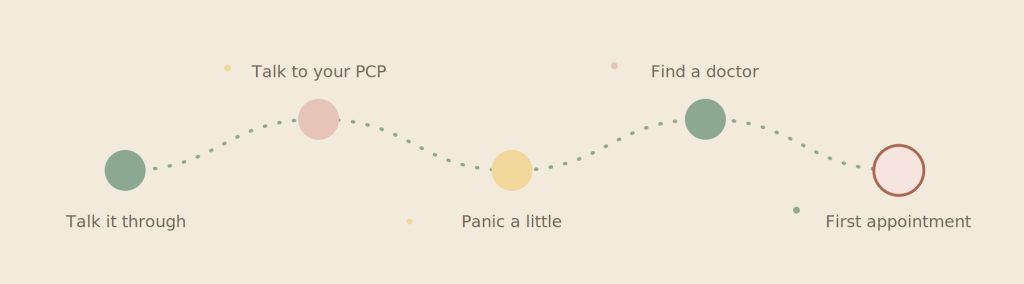
There’s no one right way to start. We started by talking a lot, and then talking some more, freaking out a little, and then showing up for each other. Your process might be different but below are some common steps that people take.
Talk it through
If you have a partner, this is the first real conversation: do we want to do this, and are we both in. It doesn’t have to be one big dramatic sit-down. Ours happened in pieces, over quite a long while.
If you’re doing this solo, the “talk it through” can be with a therapist, friends and family, and/or just with yourself (which counts the most anyway).
Talk to your primary care doctor
Your primary care provider (PCP) is a low-stakes first stop. You don’t need to have decided anything. You can just say you’re thinking about fertility stuff and want to understand your options. They can point you in the right direction, and often refer you onward.
Panic a little
This is optional but extremely common. Somewhere around here things start getting more real. And also more overwhelming. A wave of “oh god, are we actually doing this” shows up. Totally normal… we think. You can feel completely sure, completely unsure, and completely terrified all at the same time. Just breathe and keep walking forward.
Find a fertility doctor
A fertility doctor is a specialist called a reproductive endocrinologist (RE). You might get there by referral from your PCP, or you can go straight to a fertility clinic and book yourself.
Here’s more about how to choose a clinic and what to look for.
Go to your first appointment
The first one is mostly a conversation, not a procedure, and often virtually over the phone or telehealth. You’ll talk through your history, the doctor will explain what they’d look into, how IVF works, and likely some initial testing to consider.
Bring your partner, family member, or a friend if you want. Write your questions down beforehand, because you will blank during the appointment.
Bring your medical history, and your partner’s. Any prior testing, surgeries, pregnancies or losses, family history of fertility or genetic issues, your cycle details. If there’s a sperm side, that history matters too.
Know your insurance situation before you go. Find out whether your plan covers any fertility testing or treatment, which are often covered differently. For us, our insurance covered testing (under regular gynecology) but did not cover treatment. And check whether your state has any coverage mandate.
Ask about costs early on — including medications. Especially if you’re self-paying, ask for a price breakdown of every step. Ask what a full cycle consists of and costs at that clinic, including meds and any extras. Clinics vary, and the “all-in” price is often different than what they advertise (which often does not include the medication).
Expect testing first, not treatment. A lot of people show up to their appointment thinking they’ll “start IVF” and are surprised the first phase is diagnostics like bloodwork and ultrasounds. The first step is about getting a benchmark of where your body is. At future appointments, you and your doctor will discuss options and treatment.
Then what?
From there it’s testing, a plan, and the actual process (which we get into across the rest of the site). But that’s generally the start for a lot of people: talk, talk, panic, talk, find your doctor, show up. You’ve basically already started just by reading this.
Once you’ve got your footing here, the next thing most people want to understand is the money side. Our Costs section breaks down what a cycle runs for, whether insurance helps, how medications bring up the sticker price, and whether add-ons are worth it.
Learn More
Sources
- American College of Obstetricians and Gynecologists (ACOG), “Evaluating Infertility”
- American Society for Reproductive Medicine (ReproductiveFacts.org), “Diagnostic Testing for Infertility”
- American Society for Reproductive Medicine (ReproductiveFacts.org), “Defining Infertility”
- RESOLVE: The National Infertility Association